
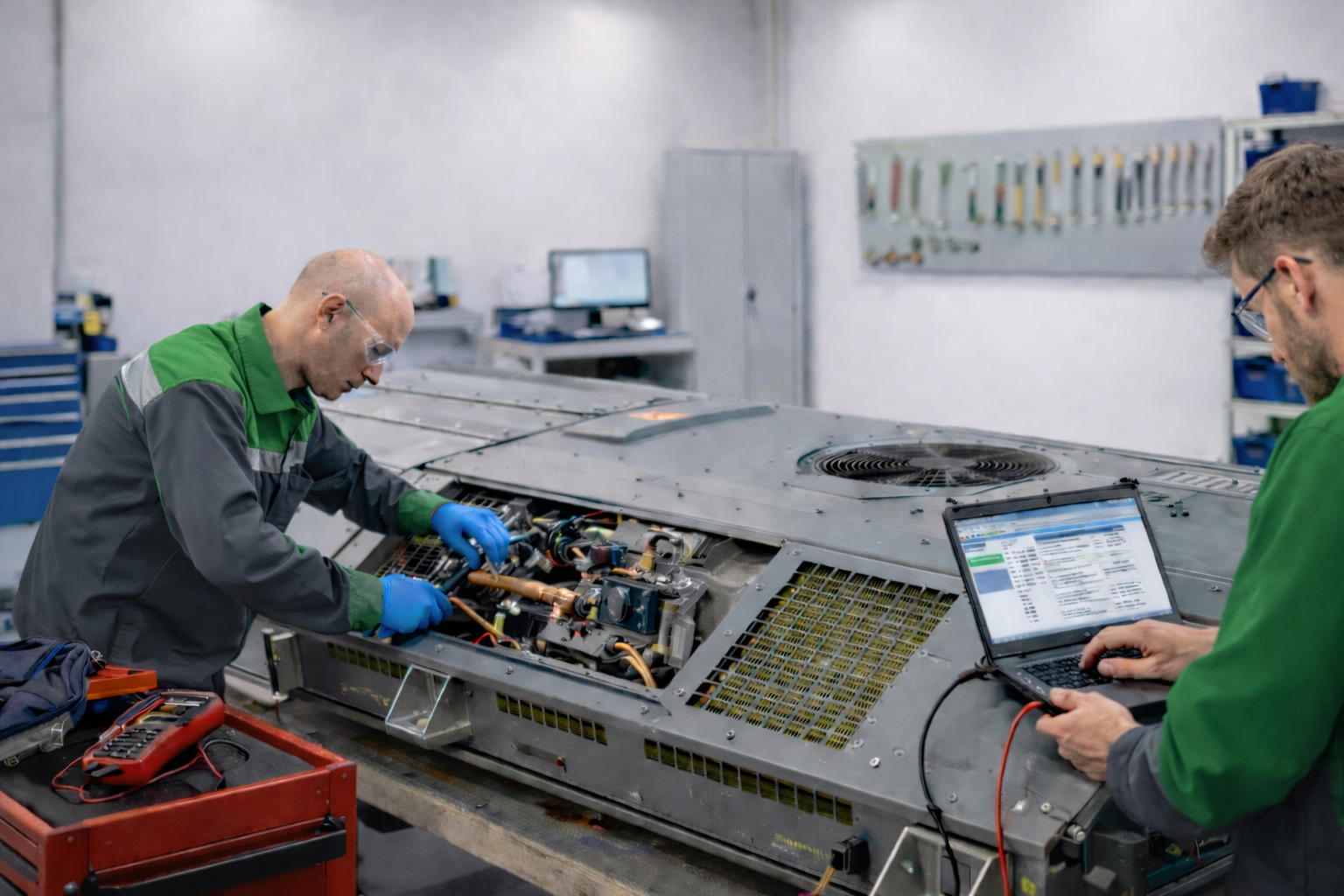
When discussing the repair and overhaul of railway vehicle components, the first thing people often talk about is technology or price. Topics such as which repair method, which spare parts, scope of work, but also prices and discounts seem to be at the forefront.
In practice, however, the picture is always different. The biggest challenge in the maintenance of components is rarely the technical realisation or the price itself.
The decisive factor is the throughput time, i.e. the time between the removal of a component and its renewed availability for vehicle use.
Numerous discussions with maintenance workshops, railway transport companies and leasing companies have revealed a clear pattern:
It is not only technical expertise that determines the success of a service partner, but above all the predictability and reliability of lead times.
Because every extended lead time has direct operational consequences for operations, workshop planning and fleet management.
This article analyses why short and predictable lead times are so crucial for component repairs and overhauls, which problems frequently occur in the market and which characteristics distinguish an efficient service partner.
1. throughput time as a critical factor in maintenance
When repairing components from rail vehicles, such as air conditioning systems, brake components, couplings, control units or hydraulic assemblies, the technical realisation is manageable in many cases.
The real challenge arises from the logistical and organisational complexity of the repair process.
A typical external component repair or overhaul of individual components involves several steps:
- Removing the component in the vehicle
- Dispatch to the repair centre
- Incoming inspection and diagnosis
- Quotation preparation and approval
- Procurement of spare parts
- Repair or overhaul
- Function test
- Return shipment to the workshop
- Reinstallation in the vehicle
Each of these steps can take time and therefore extend the overall processing time.
The problem:
The component is not available for workshops and operators during this entire period.
2. why short and predictable lead times are crucial
Long and unplannable lead times for component maintenance affect several key areas of the maintenance organisation.
2.1 Vehicle availability
The most obvious effect relates to the availability of vehicles.
If a critical component is missing, a vehicle cannot be put back into operation.
Especially with assemblies such as
- Brake components,
- Air conditioning systems,
- Door parts,
- Clutches,
- Traction components
reinstallation is a prerequisite for operational release.
Practical example: Regional railcars
A workshop is planning a scheduled overhaul of a regional railcar.
During the overhaul, a defective air conditioning system is removed and sent to an external service provider for repair.
The expected turnaround time is four weeks according to the offer.
After three weeks it turns out:
- A spare part is missing.
- The delivery date is unclear.
- The repair is delayed by a further three weeks.
The vehicle can therefore not be delivered on time.
The consequences:
- Workshop space remains blocked
- Vehicle is out of service for longer
- Replacement vehicles must be organised
A single component can therefore influence the entire workshop cycle of a vehicle.
2.2 Workshop planning and capacity management
Workshops usually work with tightly synchronised capacity plans.
Workstations, lifting equipment, tracks with roof work stands and personnel are scheduled for specific periods.
If a component is not available on time, several problems arise:
- Vehicles cannot be completed
- Jobs remain blocked
- following vehicles are delayed
- Plans have to be adjusted several times
Practical example: Clutch repair
A workshop is planning to replace several automatic clutches as part of a major maintenance programme.
The clutches are sent to an internal or external component workshop.
The planned programme:
- Expansion week 1
- Overhaul at service provider week 1-3
- Reinstallation week 4
If the repair suddenly takes six weeks instead of three, the workshop has to:
- Reschedule vehicles
- Rescheduling workplaces
- Deploy staff differently
Such changes cause considerable organisational effort.
2.3 Spare parts inventories and capital commitment
An often underestimated effect of long lead times concerns the spare parts strategy.
The longer a component is in transit for repair, the larger the stock of replacement components must be.
This so-called pool size has a direct financial impact.
Sample calculation
One operator owns a fleet of 30 vehicles.
Each vehicle has air conditioning.
With a repair throughput time of:
- 3 weeks may be enough for 2 replacement devices
- 8 weeks possibly 5 or 6 devices are needed
The difference:
Several additional components must be purchased or held in stock.
Particularly with complex assemblies, the costs can quickly reach six-digit range go.
This makes it clear:
lead time directly influences the capital commitment in the exchangeable parts inventory.
2.4 Fleet reliability
The effect of long repair times is particularly critical in the case of:
- small vehicle fleets
- specialised vehicle types
- historic or rare vehicles
There are often only a few replacement components.
Practical example: Special fleet
One operator runs a small fleet of eight specialised vehicles.
The vehicles have a specific door system whose components can only be overhauled by a small number of suppliers.
If a door control unit is sent for repair and the turnaround time is several months, this can lead to the following:
- Vehicles remain out of service for longer
- Lack of operational reserves
- Malfunctions occur more frequently
Each component is disproportionately important, especially for small fleets.
3. the expectations of workshops and operators
Interestingly, many discussions about repair service providers initially focus on price. However, other priorities become apparent in practical cooperation. Workshops and operators expect reliability and predictability above all from external service partners.
3.1 Plannable throughput times
The most important requirement is rarely the shortest possible repair time. Rather, the decisive factor is that a promised lead time must be realistic and reliable.
Enables a predictable repair time:
- Stable workshop planning
- Reliable vehicle scheduling
- Clear spare parts strategies
Optimistic estimates that have to be corrected later, on the other hand, cause considerable problems.
3.2 Transparent communication
During the repair phase, customers want clear information about the status of the component.
Typical questions are:
- When are the findings made?
- What damage was detected?
- Which spare parts are required?
- When will the repair be completed?
A lack of communication often leads to uncertainty and additional coordination effort.
3.3 Reliable scheduling
Another decisive factor is the resilience of deadline commitments.
Many repair companies specify dates that can be reached under optimal conditions.
In practice, however, delays often occur:
- Internal capacity utilisation
- Missing spare parts
- Additional damage patterns
- Staff shortages
Workshops, on the other hand, need schedules that work even under high capacity utilisation.
3.4 Technical expertise
In addition to organisational factors, technical expertise naturally also plays a key role.
An efficient service partner has:
- In-depth understanding of the components
- Experience with typical damage patterns
- Knowledge of the vehicles in which the components are installed
- Access to suitable inspection and test equipment
This technical depth enables not only repairs, but also practical solutions for recurring problems.
4 The reality of the market
Despite clear expectations, many operators and workshops in the market are confronted with recurring challenges.
The most common problems include
- Long reporting times
- Unclear repair dates
- Low transparency during the repair
- Prioritisation according to internal capacity utilisation
- Missing spare parts
Lead times can quickly extend to several months, especially for specialised railway components.
Example: Brake components
An operator sends several brake valves for overhaul.
The repair company needs:
- Four weeks until diagnosis
- another week until the offer is prepared
- Additional time for spare parts procurement
These steps alone can take several weeks to several months before the actual repair begins. If, for example, a cast housing has to be replaced, this can take several months.
Such processes often arise not from a lack of expertise, but from a lack of structured processes and a lack of spare parts stocks.
5 What characterises an efficient service partner
From the point of view of many workshops, four key factors can be identified that make a good external repair partner.
5.1 Structured processes for diagnosis and repair
The first decisive factor is clearly defined processes.
An efficient repair process includes:
- Fast incoming goods inspection
- Prompt diagnosis
- Clear documentation of the damage
- Structured offer preparation
- Defined repair steps
The aim is to be able to draw up a reliable schedule at an early stage.
Practical example
A specialised repair company introduces standardised diagnostic processes.
Every incoming component is processed within 48 hours:
- registered
- Technically tested
- documented
The customer receives immediate feedback on:
- Damage pattern
- Scope of repair
- Estimated lead time
This approach significantly reduces uncertainties.
5.2 Plannable capacities
The second important factor concerns capacity management.
A professional service partner plans its resources in such a way that promised throughput times can be adhered to even at high capacity utilisation.
This can be achieved by the following measures, for example:
- Reserved capacities for certain customers
- Defined priority levels
- Separate lines for series repairs
- Flexible personnel planning
The goal is not maximum capacity utilisation, but reliable delivery capability.
5.3 Functioning spare parts supply
The third factor is when and how spare parts are procured. Thanks to their expertise, efficient service partners know which spare parts can become defective and keep them in stock so that they are available when needed. Alternatively, they have very short delivery times from their suppliers. This means that repairs and overhauls can be completed quickly in >95% of cases, depending on the agreed service level, without any time being lost waiting for materials.
5.4 Technical expertise and practical solutions
The fourth factor is the technical depth in the background.
Experienced specialists can often develop solutions that go beyond mere repairs.
Examples:
- Improvements to wear-prone components
- Alternative spare parts
- Optimisation for recurring damage patterns
- Support with fault analysis in the vehicle
This technical co-operation creates long-term added value for operators and workshops.
6 The role of external specialists
Many workshops have a high level of technical expertise, but reach their limits with certain components.
Typical reasons:
- Small quantities
- Lack of specialised test benches
- Rare repairs
- Limited human resources
External specialists can provide targeted support here.
They concentrate on certain assemblies and develop them:
- Specific expertise
- Suitable test methods
- Efficient repair and overhaul processes
- Stocking of spare parts
This enables them to take on tasks that could only be mapped internally at great expense.
However, the prerequisite for this is that they not only provide technical expertise, but also the ability to plan.
7 Conclusion: lead time is a strategic factor
The importance of lead time is often underestimated in the maintenance of railway vehicles.
But in practice, this has been shown time and again:
A repair doesn't just take „a few weeks“.
It often influences the entire workshop cycle of a vehicle.
Short and predictable throughput times have a direct impact on:
- Vehicle availability
- Workshop planning
- Spare parts stocks
- Fleet reliability
This is why workshops and operators are not just looking for repair companies, but reliable technical service partners. Partners who:
- have structured processes
- Enable realistic scheduling
- Offer transparent communication
- and have in-depth technical expertise.
Especially with complex and specialised railway components, this combination can make the decisive difference between a functioning maintenance strategy and recurring operational problems.