
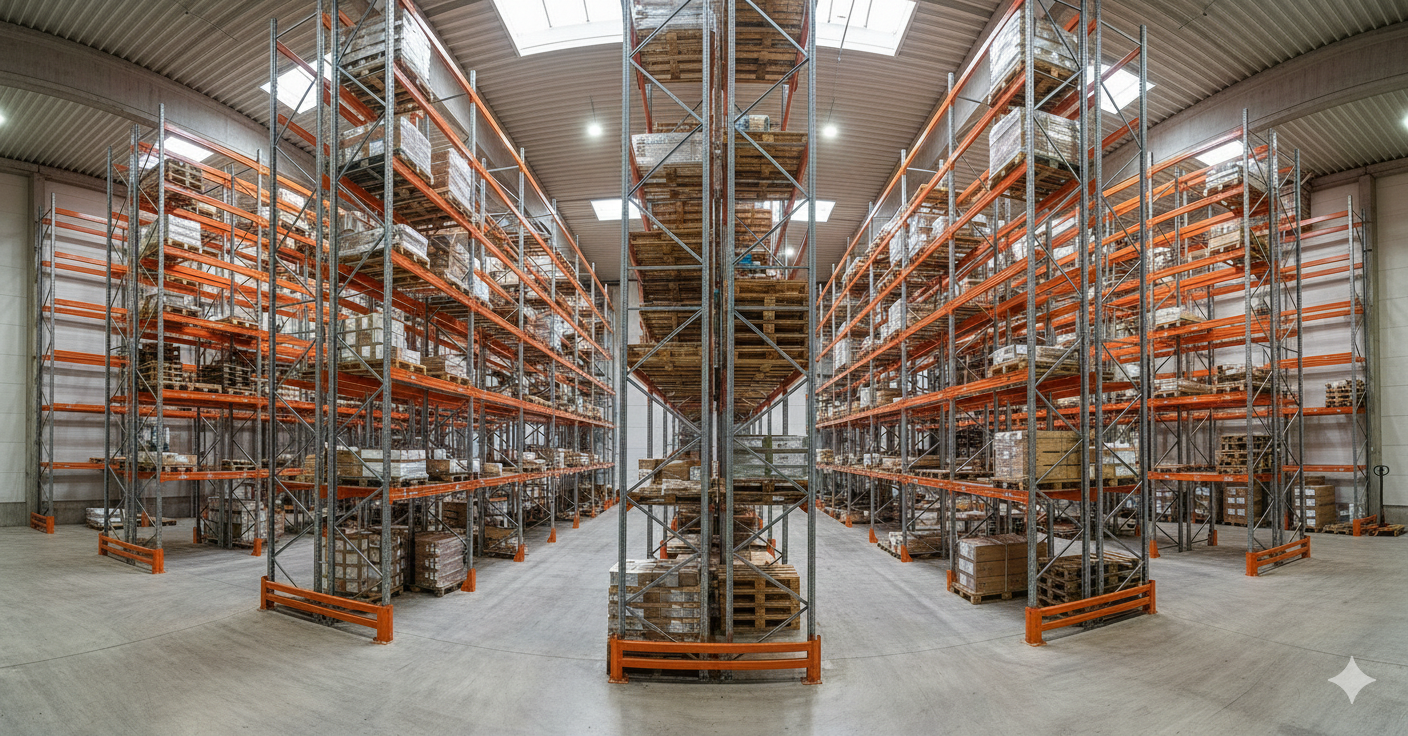
In rail vehicle maintenance, timely access to spare parts determines the operational readiness of entire fleets. Even the absence of a single spare part number can result in trains being out of service for days or even weeks. This has a direct impact on punctuality, workshop processes, cost structures and customer satisfaction.
Material shortages are no longer an exception. Today, they are one of the most common causes of extended downtime in the rail sector. While technical defects can usually be diagnosed quickly, vehicles often remain out of service simply because the necessary components are not available in time.
This article examines why bottlenecks arise, how they affect vehicle availability, and which measures have proven effective in practice for sustainably increasing supply security.
Why do material shortages occur with spare parts?
The causes are manifold and often interlinked. In practice, several factors simultaneously have a cumulative effect on delivery capability and stock availability.
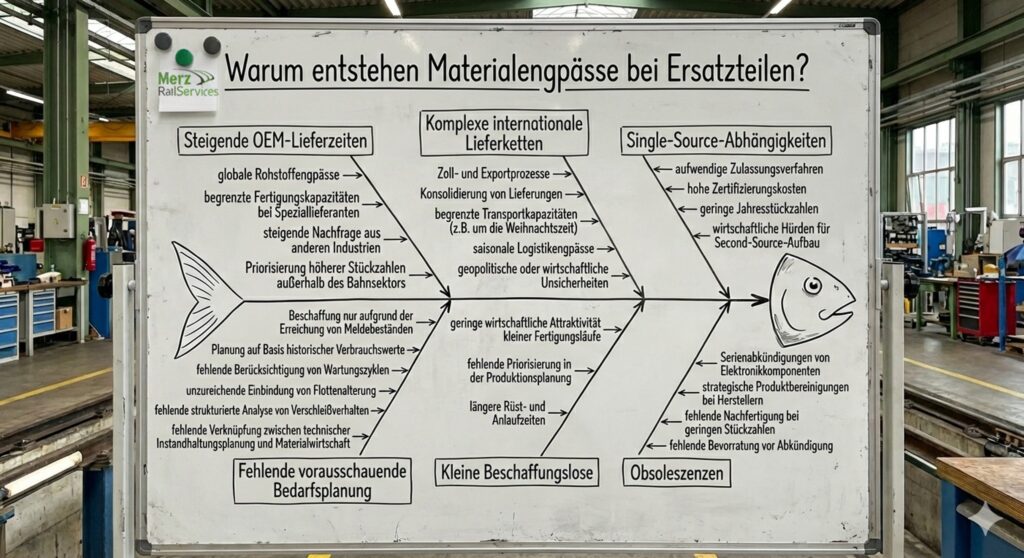
Increasing OEM delivery times
Many manufacturers now work with significantly longer lead times. Delivery times of 10 to 40 weeks are common for industry-specific standard components. For cast, forged, electronic or special components, delivery times can be twelve months or more. The reasons for this are:
- global commodity shortages
- limited production capacities at specialist suppliers
- increasing demand from other industries
- Prioritisation of higher volumes outside the rail sector
The result: spare parts are generally available, but not within the time frames required by railway workshops.
Complex international supply chains
Spare parts are rarely manufactured locally. Instead, there are international supply networks with numerous interfaces. Delays arise due to:
- Customs and export processes
- Consolidation of deliveries
- Limited transport capacities (e.g. around Christmas time)
- Seasonal logistics bottlenecks
- Geopolitical or economic uncertainties
Each additional interface increases the vulnerability of the supply chain to disruptions.
Missing forward-looking demand planning
In many organisations, material planning is still reactive. Common weaknesses include:
- Procurement only based on reaching reorder points
- Planning based on historical consumption values
- Lack of consideration of maintenance cycles
- Insufficient integration of fleet ageing
- Lack of structured analysis of wear behaviour
- Lack of link between technical maintenance planning and materials management
This results in unexpected peaks in demand, especially for components that are replaced based on their condition.
Small procurement batches
Workshops and operators often place orders for small quantities. For manufacturers and their suppliers, this results in:
- low economic attractiveness of small production runs
- lack of prioritisation in production planning
- longer set-up and start-up times
Especially in the case of cast and forged parts, rail orders are often given lower priority than automotive or industrial customers.
Single-source dependencies
Many safety-related components may only be sourced from approved manufacturers. Typical conditions:
- Complex authorization procedures
- High certification costs
- Low annual production volumes
- Economic obstacles to establishing a second source
If a supplier fails to deliver or delivers late, there is no alternative in the short term.
Obsolescence
Rail vehicles are designed for a service life of 30 years or more. Electronic assemblies, on the other hand, have significantly shorter product cycles. Typical effects:
- Discontinuation of electronic components
- Strategic product rationalisation by manufacturers
- Lack of reproduction for small quantities
- Lack of stockpiling prior to discontinuation
Without early obsolescence planning, supply gaps arise with immediate risks of downtime.
The direct impact on vehicle availability
In practice, material shortages often cause greater operational restrictions than technical defects themselves.
Extended downtimes
A vehicle may be technically fully functional. However, if a safety- or function-related component or components that directly affect customer comfort are missing, it must not be put into service. The following assemblies are typically affected:
- Door systems
- Brake components
- Coupler parts
- HVAC modules
- Electronic control units
- Traction motors and converters
- Sanitary and water systems
Even the absence of a relatively small component can block an entire vehicle unit.
Delayed maintenance and inspections
A lack of spare parts or consumables leads to:
- planned revisions being postponed
- inspection intervals not being adhered to
- preventive measures being suspended
- an increased risk of unplanned downtime
Maintenance loses its predictable structure.
Overloaded workshops
Material bottlenecks create operational inefficiencies:
- Unplanned downtime blocks hall capacity.
- Workstations are occupied even though no productive work is possible.
- Staff must be rescheduled at short notice.
- Postponed dates create additional administrative work.
The result is declining throughput rates and rising process costs.
Reduced punctuality
Unavailable vehicles lead to:
- Circulation reductions
- Last-minute vehicle replacements
- Use of replacement trains
- Reduced seating capacity
For passengers, this means unreliability.
Cost increases
Material shortages cause significant additional costs:
- Contractual penalties for SLA violations
- Costs for substitute vehicles or subcontractors
- Express logistics and special transport
- Overtime in the workshop and purchasing department
- Additional administrative costs
The total operating costs rise significantly above the planned level.
Domino effects in maintenance
The lack of individual components delays follow-up work:
- Vehicles block workstations
- Other maintenance tasks cannot be completed
- Materials for subsequent steps cannot be used
- Capacity planning loses its control effect
This creates chain reactions throughout the entire service process.
The invisible and long-term consequences
Material shortages have an impact far beyond the technical level and affect organisational, economic and strategic aspects.
Loss of planning reliability in workshops
Unpredictable parts shortages prevent reliable capacity and schedule planning. Workshops lose the ability to manage maintenance windows, personnel resources and hall occupancy in a stable manner over the long term.
Declining reliability of fleet availability
Recurring material shortages lead to fluctuating vehicle availability and make it difficult to plan reliable circulation and deployment. Operational management is becoming increasingly reactive rather than proactive.
Rising total cost of ownership
An increased failure rate of the vehicle fleet requires the use of additional vehicles to ensure operations, which leads to rising investment costs. At the same time, parked vehicles generate no revenue and worsen the company's bottom line.
Short-term circulation and maintenance shifts create additional planning effort, which increases administrative personnel costs.
Overall, the total cost of ownership increases significantly beyond the calculated life cycle costs.
Inefficient use of highly qualified specialists
Technical specialists spend valuable working time waiting for parts, rescheduling or administrative coordination instead of performing productive maintenance work.
Increased friction between OEMs, operators and maintenance providers
Delivery delays and unclear responsibilities lead to conflicts of interest, escalations and increased coordination efforts along the entire value chain.
Growing management attention to operational crises
Managers are increasingly preoccupied with short-term problem solving and escalation management, pushing strategic development and process optimisation into the background.
Loss of trust among passengers and the public
Repeated service disruptions undermine passenger confidence in the operator in the long term. This leads to a loss of image, negative media coverage and increased political pressure.
Which spare parts are particularly prone to shortages?
Certain groups of parts are structurally more susceptible to shortages:
Safety-related components
- Brakes
- Door systems
- Couplers
- Control electronics
Components with long procurement times
- Cast and forged parts
- Custom-made parts
- Weld-intensive assemblies
Vehicle-specific components
- Non-standard designs
- Limited quantities
- Parts that are only replaced in the event of an accident or damage.
Varied spare parts
- Numerous design variants
- Complex article master lists
- Difficult warehousing
Components subject to testing and certification requirements
- Fire & Smoke protection requirements
- Material certificates (e.g. 3.1 / 3.2)
- Authorities approvals
In this case, the delivery time is further extended by testing and documentation processes.
Solutions for reducing material shortages
Material shortages are not inevitable. They can be significantly reduced through structured spare parts management.
Availability-based warehousing (service level agreement)
- Strategically located warehouses close to workshops shorten transport routes and ensure quick access to critical spare parts.
- Defined minimum availability levels ensure that essential components are always kept in sufficient quantities.
- Binding delivery time agreements create planning security and reduce the risk of short-term supply bottlenecks.
- Transparent inventory management provides an overview of stock levels, movements and replacement requirements at all times.
Data-based demand planning
- The linking of maintenance planning and materials management ensures coordinated control of maintenance processes and spare parts supply.
- Taking fleet condition and mileage into account enables realistic forecasting of future material requirements.
- Statistical failure probabilities form the basis for reliable forecasts and avoid unexpected peaks in demand.
- Continuous adjustment of forecasts ensures that planning models remain synchronised with real operating data.
Supplier consolidation
- Reducing interfaces simplifies communication channels and minimises coordination efforts in the supply chain.
- Clearly defined responsibilities create transparency and accelerate decision-making processes in the event of deviations.
- Improved supplier management increases security of supply and enables targeted prioritisation of critical requirements.
- Greater negotiating and prioritisation power improves your position vis-à-vis suppliers and stabilises delivery commitments.
Kitting and logistics packages per train
- Pre-assembled material packages ensure that all components required for an overhaul are provided in full.
- Complete equipment for standard overhauls reduces interruptions during maintenance work.
- Reduced material retrieval times increase workshop productivity and shorten throughput times. Only one material number is retrieved instead of each material number individually.
- Lower error rates in material provision increase process quality and avoid rework.
Predictive maintenance
- Continuous condition monitoring enables early detection of wear and tear.
- Data-based failure forecasts provide the basis for predictive maintenance decisions.
- Timely stocking before damage occurs prevents part shortages that cause downtime.
- Optimised replacement times extend the service life of components and reduce unplanned downtime.
Incoming goods inspection and documentation management
- Early quality controls ensure that spare parts are delivered correctly and in working order.
- Complete technical documentation ensures compliance with regulatory requirements.
- Avoiding installation stoppages reduces delays in the workshop and ensures stable workflows.
- Rapid complaint handling enables a timely response to quality deviations.
Independent procurement optimisation
- Technical assessment of criticality enables prioritised management of the spare parts portfolio.
- The analysis of revision cycles forms the basis for demand-oriented stocking strategies.
- Risk-based stocking strategies reduce capital commitment while ensuring a high level of supply security.
- Continuous optimisation of inventories ensures that warehousing and demand development remain in balance in the long term.
Conclusion: Material bottlenecks are one of the biggest killers of availability
A lack of spare parts is often the real reason for vehicles being out of service, rather than a lack of technology or workshop capacity.
Many shortages arise due to:
- Uncoordinated procurement processes
- Lack of transparency in supply chains
- Incorrectly dimensioned warehouses
- Unclear prioritisation
- Lack of strategic spare parts planning
Vehicle availability and operational reliability can be improved in the long term with structured spare parts management, SLA-based warehousing, forward-looking demand planning and professional logistics.
A systematically implemented spare parts management system reduces bottlenecks and increases the performance of entire fleets.