
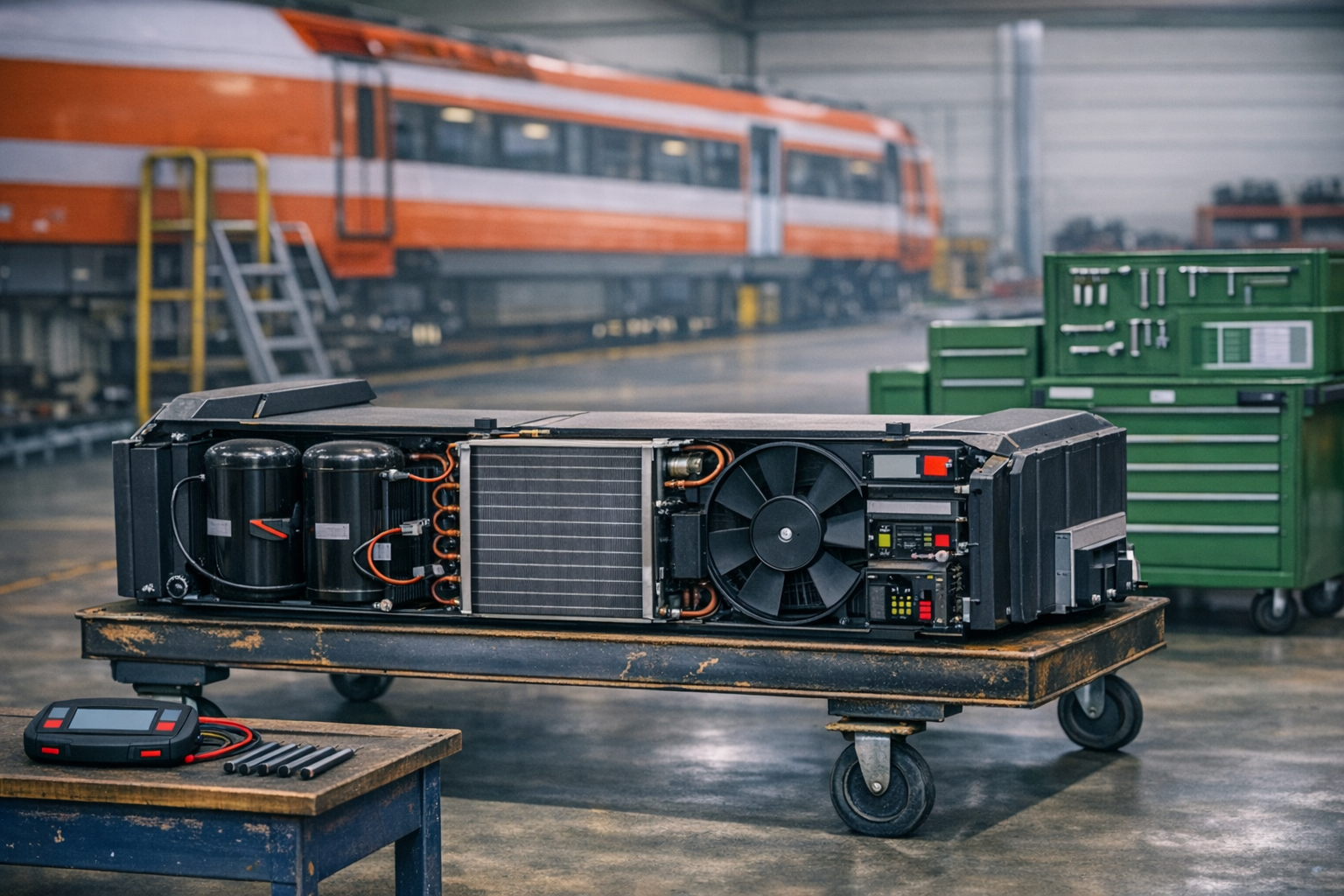
How maintenance strategies are changing, using the example of HVAC systems in rail transport
1. Introduction: Why component maintenance is at a turning point
The maintenance of rail vehicles has been undergoing a fundamental shift for several years. Increasing demands for vehicle availability, economic pressure across the entire lifecycle, and growing regulatory responsibility for holders and ECMs are changing the way maintenance is organised, planned and carried out.
This change is particularly evident at the level of Component Maintenance. Whereas previously entire assemblies were often swapped or overhauled at fixed intervals, the question is increasingly coming into focus today, which components are to be repaired, when, to what extent, and on what basis of decision.
A particularly suitable example of this development is HVAC systems (Heating, Ventilation and Air Conditioning or HVAC in German) for railway vehicles. They combine several aspects that are typical of modern maintenance strategies:
- high technical complexity,
- immediate impact on operations and passenger comfort,
- different lifecycles of individual sub-components,
- and a wide variety of options depending on the vehicle type and manufacturer.
The view on HVAC maintenance therefore allows fundamental developments in component maintenance to be made visible, from classic, time-based approaches to condition and data-driven strategies.
2. Status quo: Classic maintenance models for HVAC components
Time-based maintenance as the standard model
In many workshops and maintenance organisations, time-based maintenance remains the dominant model. HVAC components are maintained at set intervals:
- extended,
- checked,
- overtaken or
- completely replaced.
This approach offers clear advantages: processes are established, operations are easily planned, and regulatory compliance is readily demonstrable. At the same time, however, it is becoming increasingly apparent that this model only partially meets the real operating conditions of modern vehicles.
HVAC systems are subject to very different loads depending on the area of application, driving profile, climatic conditions, and intensity of use. Fixed intervals only inadequately take these differences into account and frequently lead to Over-maintenance, while simultaneously other components are operated undetected up to their load limits.
Reactive maintenance and its risks
In practice, certain HVAC sub-components are still repaired reactively, i.e. only when a fault occurs. This approach appears economically sensible at first glance, especially for secondary components.
However, reactive maintenance on HVAC systems carries specific risks:
- Vehicle impoundments due to comfort defects,
- Operational restrictions at extreme temperatures,
- potential consequential damage to adjacent systems,
- as well as negative effects on the passenger's perception.
The actual cost of an unplanned HVAC failure is often underestimated and extends far beyond the mere repair.
Typical Workshop Challenges
Furthermore, structural frameworks are exacerbating the situation:
- heterogeneous vehicle fleets with different HVAC generations,
- limited spare parts availability,
- growing shortage of skilled workers,
- as well as increasing documentation.
These factors make it clear that traditional maintenance models are reaching their limits, particularly with complex components such as HVAC systems.
3. Drivers of change in component maintenance
The shift in component maintenance is not a singular phenomenon. It is triggered by several mutually reinforcing drivers that cannot be considered in isolation in practice. Technological developments, regulatory requirements, economic pressure, and sustainability goals operate in parallel and are changing the way maintenance decisions are prepared and made.
Technological development and increasing system complexity
Modern rail vehicle components are significantly more complex today than they were just a few years ago. HVAC systems are a typical example of this development. They combine mechanical assemblies, electric drives, power electronics, sensors, and software within one system.
This also changes the requirements for maintenance:
- Operational data such as temperatures, pressures, run times, or current draws are generally available
- Diagnostic functions provide indications of deviations and incipient fault patterns.
- At the same time, the need for system understanding is increasing in order to correctly interpret this data.
The mere availability of data does not yet lead to better decisions. Only the combination of technical expertise, structured examination, and root cause analysis enables a reliable condition assessment. Technological development is therefore a key driver for the transition from fixed intervals to differentiated, condition-based maintenance strategies.
Regulatory requirements and responsibility in the ECM environment
Alongside technical development, regulatory requirements have also evolved significantly. The clear assignment of responsibilities within the ECM system increases the demands for traceability, documentation, and decision logic in maintenance.
For component maintenance, this means, among other things:
- Measures must be technically justified and documented.
- Decisions regarding repair, replacement, or continued operation must be traceable.
- Exchanges based on suspicion or blanket measures are losing acceptance.
It is no longer enough to carry out a measure correctly, especially for operationally relevant components like HVAC systems. It must also be clearly evident why this measure was chosen and which alternatives were considered. The regulatory framework thus acts as a driver for structured assessment processes, clean documentation, and clear decision-making rules in component maintenance.
Economic pressure and focus on life cycle costs
Another key driver is the increasing economic pressure on operators and maintenance organisations. Spare parts are becoming more expensive, lead times are lengthening, and unplanned vehicle downtime has a direct impact on operations.
In practice, this leads to a changed assessment of maintenance measures:
- Individual costs fade into the background when considering life-cycle costs.
- Lead times and vehicle availability are becoming crucial key figures.
- Tying up capital through early replacement is gaining importance
This connection becomes particularly clear using HVAC components as an example. A complete replacement may seem simple in the short term, but it often leads to unnecessary capital tie-up and increases dependency on spare parts availability. Targeted repairs, modular maintenance, and condition-based decisions, on the other hand, enable better control of costs and availability over the entire life cycle.
Sustainability and climate protection as a strategic driver
Beyond technology, regulation and economic viability, sustainability is increasingly gaining strategic importance. Environmental and climate protection now directly influence maintenance strategies and decision-making logic.
In component maintenance, this driver is particularly evident:
- Replacing a component causes emissions from manufacturing, transport, and logistics.
- Complex systems such as HVAC installations have a correspondingly high ecological footprint.
- Extended service life through targeted repairs reduces material consumption and emissions
Sustainable maintenance does not mean operating components for as long as possible, regardless of their condition. It means:
- Operate for as long as technically feasible and responsible.
- Making decisions based on condition, load and wear
- Exchange should only be carried out if it is technically justified.
Condition-based monitoring, clean diagnostics, and targeted repairs of subcomponents are the prerequisite for this. Sustainability thus becomes an integral part of modern maintenance strategies and influences technical, economic, and organisational decisions equally.
These four drivers explain why component maintenance is currently undergoing fundamental change. They also show why simple solutions or individual measures are not enough. The future lies in integrated strategies that jointly consider technology, responsibility, economic efficiency, and sustainability.
4. Condition-Based & Predictive Maintenance: Theory Meets Practice
Condition-based maintenance for HVAC systems
Condition‑Based Maintenance (CBM) describes an approach where maintenance measures are planned based on the actual condition of a component. For HVAC systems, numerous parameters can be used for this purpose, such as:
- Deviations from target temperatures,
- altered pressure conditions in the refrigeration circuit,
- unusual power consumption from compressors,
- or increased runtimes for certain assemblies.
This information allows wear to be detected early and for targeted action to be taken before a failure occurs.
Predictive Maintenance as a further development
Predictive maintenance approaches go one step further. Here, historical data, pattern recognition, and statistical models are used to predicting future failures.
Using HVAC systems as an example, this allows for, for instance:
- gradual refrigerant loss,
- Developing bearing or compressor damage,
- or increasing pollution of heat exchangers
identify early.
Limitations in implementation
In practice, however, these concepts also reach their limits. Many existing vehicles are not designed for comprehensive condition monitoring, data is fragmented or not standardised. Furthermore, the question of economic viability in relation to the vehicle's value and remaining service life always arises.
Condition-based and predictive maintenance are therefore not ends in themselves, but must Targeted and pragmatic to be used.
5. Practical Example HVAC: How Maintenance Strategies Specifically Change
From complete replacement to a differentiated component strategy
A key trend in HVAC maintenance is the move away from replacing entire units wholesale. Instead, the focus is shifting towards the targeted repair of individual sub-components, such as:
- Fan motors,
- Power electronics,
- or controls.
This differentiation enables technical risks to be controlled more effectively, while simultaneously reducing material and cost expenditure.
Modularisation and standardisation
In parallel, the modularisation of HVAC systems is gaining importance. Standardised modules facilitate:
- stocking of spare parts,
- the diagnosis,
- as well as repair in specialised workshops.
This can make a significant contribution to reducing lead times, especially for fleets with multiple vehicle types.
Data-driven decision-making
The central question is increasingly no longer „What do the intervals dictate?“, but rather:
- What is the actual technical condition?
- Which measure is economically and operationally sensible?
Structured assessment and comprehensible decision-making logic thus become central elements of modern component maintenance.
6. Impact on workshops, operators and manufacturers
Workshops in transition
Workshops are increasingly evolving from pure repair operations to technical service providers. In addition to manual expertise, diagnostic ability, system understanding, and documentation quality are gaining in importance.
Operators and ECM organisations
New opportunities arise for operators and ECMs in controlling availability, but also new requirements for planning, controlling, and interface management, particularly with external maintenance services.
Manufacturers and system suppliers
Manufacturers are also facing changing conditions. Traditional after-sales models are being supplemented by long-term service and support concepts that take the entire lifecycle of an HVAC component into account.
7. The role of external technical services
Not every organisation can or needs to maintain all competencies internally. External technical services are increasingly taking on specialised tasks in component maintenance, for example with complex HVAC systems or during capacity bottlenecks.
Crucial for the success of such collaborations are:
- clear technical interfaces,
- transparent reporting,
- justifiable grounds for decision,
- as well as reliable turnaround times.
8. Outlook: HVAC Maintenance in Ten Years
The HVAC maintenance of the future will be more data-driven, modular, and organised with a greater division of labour. Automated diagnostics, standardised component strategies, and closer cooperation along the value chain will become increasingly important.
At the same time, technical expertise remains a key factor for success. Data alone does not replace sound judgement, but it does support it.
9. Conclusion: Sustainable component maintenance requires strategy
HVAC systems exemplify how component maintenance in rail transport is changing. The shift from fixed intervals to condition- and data-based decisions opens up new opportunities, but requires clear strategies, suitable processes and technical understanding.
It is not technology alone that determines success, but its sensible application in the operational context. Those who think strategically about component maintenance today lay the foundation for stable vehicle availability tomorrow.