
Materials requirements planning in the rail vehicle sector is one of the most complex disciplines within maintenance logistics. Trains consist of thousands of components, which wear out differently and whose replacement must be planned as part of fixed or condition-dependent maintenance cycles. Efficient planning based on Bills of Materials (BOM) and maintenance schedules therefore forms the backbone of an economical and reliable train fleet.
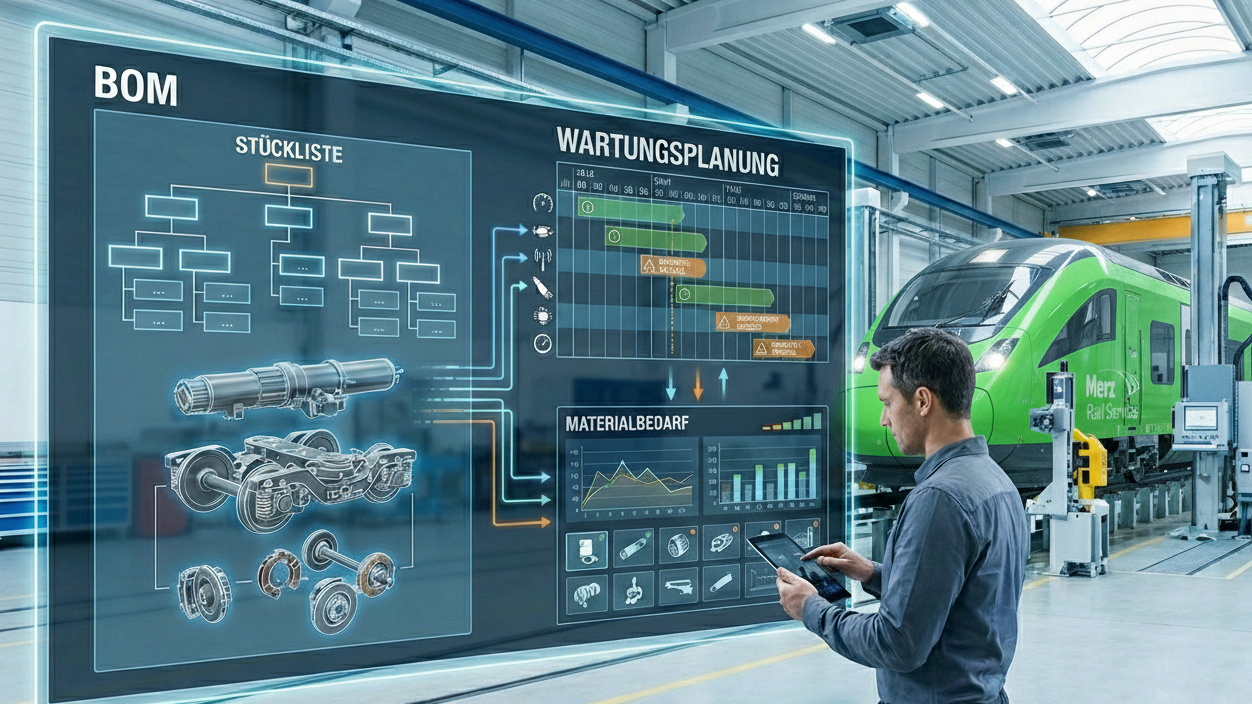
The central starting point is the precise and hierarchically structured bill of materials (BOM). It contains all assemblies, sub-assemblies, and individual parts of the vehicle, from the bogie and braking systems to the smallest fasteners. A complete, versioned, and engineering-compliant BOM is essential as it forms the basis for identifying relevant spare parts. Particularly in the rail sector, where vehicle series are operated and modernised over decades, even minor discrepancies between technical documentation and the actual vehicle can have significant consequences for material planning.
Alongside the bill of materials, maintenance planning must be considered. Railway operators typically work with predefined maintenance levels based on years/months and/or mileage-driven intervals. Each maintenance level requires specific activities, which in turn necessitate certain materials. If these activities are mapped in a digital maintenance plan, the resulting material requirements can be reliably forecasted. The combination of cyclical maintenance and condition-based maintenance, where sensors record component wear and generate dynamic material requirements, is particularly effective.
The challenge now lies in intelligently linking parts lists and maintenance schedules. Modern MRP and ERP systems allow for the assignment of materials from the parts list to specific work orders within the maintenance plan. If this is not possible through systems, it can be done with external programmes and database systems. This creates a transparent, time- and quantity-based overview of demand. As soon as a vehicle reaches a certain mileage or a maintenance event is scheduled, the system automatically generates the required material requirements. This not only enables precise planning but also optimises inventory levels and prevents missing parts that would unnecessarily take trains out of service for extended periods.
Furthermore, the consideration of delivery times and obsolescence plays an important role. Many components of trains are no longer produced over long periods, meaning that early procurement or spare parts strategies such as „life-time buy“ and re-engineering become necessary. Forward-looking material requirements planning identifies such risks early on and enables appropriate measures to be taken.
Another success factor is the integration of data-driven methods. By using predictive maintenance algorithms, statistical probabilities of failure can be modelled, allowing dynamic material requirements to be predicted more precisely. Furthermore, simulations help to assess the impact of different maintenance strategies on inventory and availability.
In summary, material requirements planning based on bills of materials and maintenance schedules enables efficient, cost-saving, and reliable train maintenance. It combines technical documentation, operational maintenance, and logistical processes into an integrated control tool that is indispensable for the high demands of modern railway operations.